
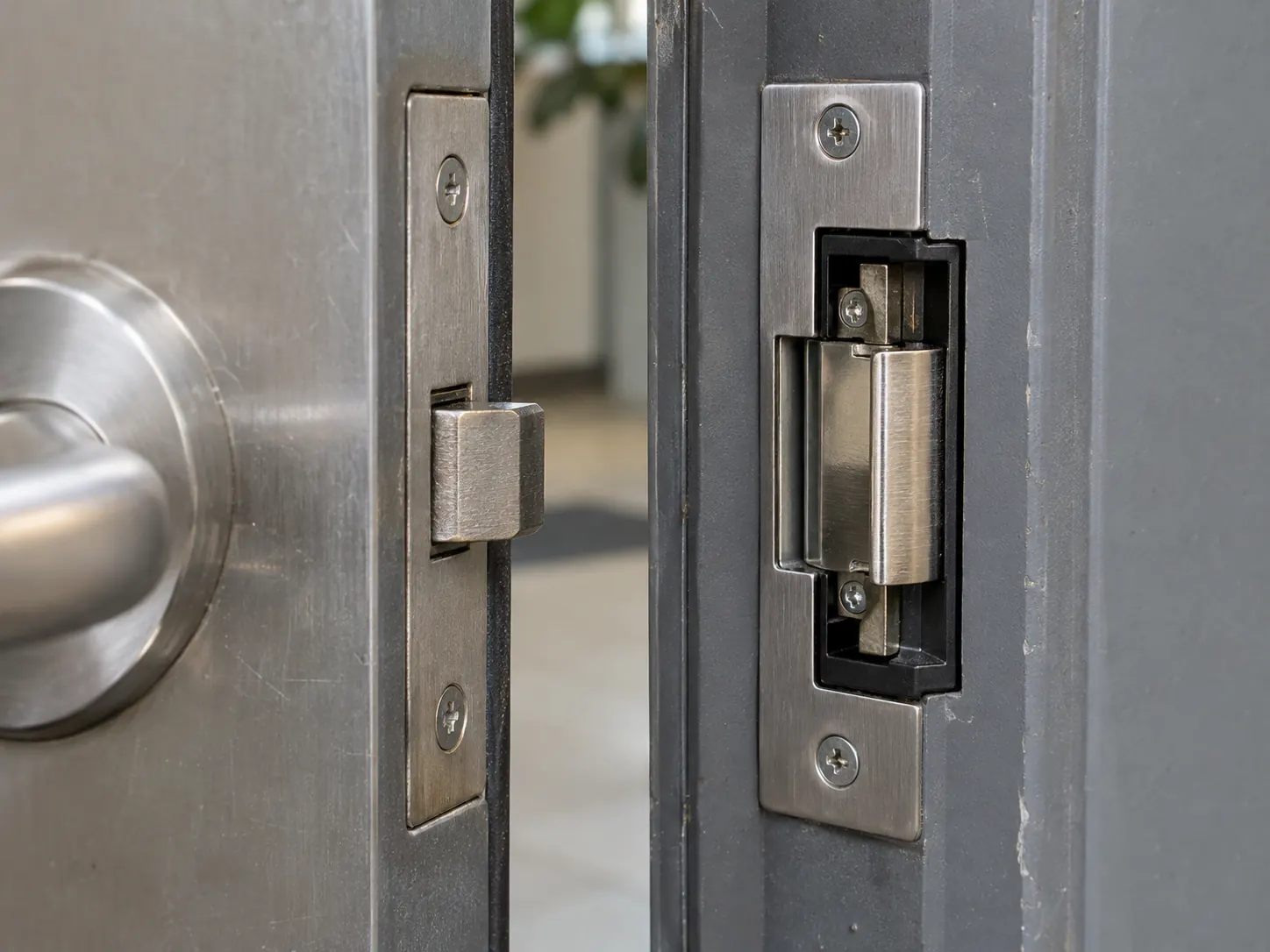
Two ways to release a door
| Electric strike | Magnetic lock | |
|---|---|---|
| How it works | Replaces the latch plate in the frame. Releases the latch when powered. | A magnet on the frame holds a plate on the door. Releases when power is cut. |
| In a power cut | Can be set to stay locked or release | Releases |
| Suits | Most doors with a latch or lockset | Glass doors, double doors, doors where the frame can't be cut |
| Needs | A frame that can take the strike | A request-to-exit button or sensor inside |
Why strikes fail
- The door sags or the frame moves, and the latch binds against the strike.
- The strike is held open too long and burns out.
- The wrong voltage, or AC on a strike built for DC.
- Wear, after hundreds of thousands of releases.
See door release repair for symptoms.
Getting out safely
Every locked entrance must open from the inside without a key, code or special knowledge. With magnetic locks that means an exit button, a motion sensor, or both, wired to release the lock. We fit these to the codes that apply.
What it costs
Contact us for a price.
Common questions
Which is better, a strike or a magnetic lock?
For most single wooden or steel doors with a latch, a strike. For glass and double doors, often a magnetic lock.
Our door doesn't lock again after it's buzzed. Is that the strike?
Usually, or the door closer. It is a security problem worth fixing promptly.
Can you fit a strike to an old door?
Yes, in most cases. Surface-mounted strikes avoid cutting historic frames.