
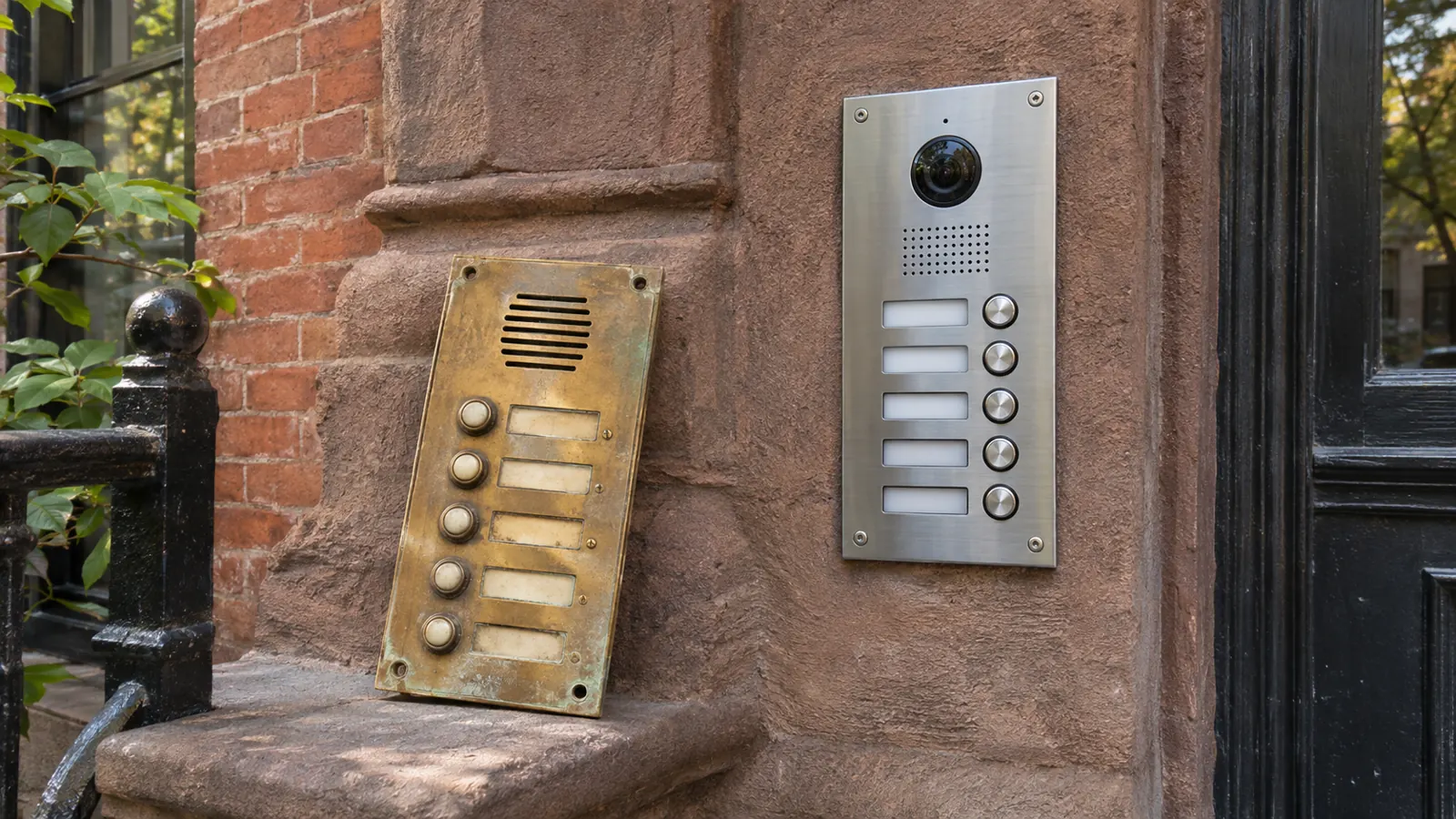
When a building is due
- Repairs have been called several times in a year, and different parts keep failing.
- Parts for the system are discontinued and no compatible replacement exists.
- Riser wiring is failing on several lines.
- Ownership wants video, smartphone answering, delivery access or remote management from the office.
- The building is being repositioned and the entrance needs to match.
One failed part isn't a reason to replace. If a contractor has quoted a full system for a single fault, get a second opinion.
The four levels of replacement
| Level | What changes | Apartment access |
|---|---|---|
| New entry panel | The panel at the door, on the existing system | None |
| Like-for-like renewal | Panel, amplifier and stations, same type, same wire | A short visit per unit |
| Conversion on existing wire | A new system, often video, on the building's risers | A short visit per unit |
| Cloud or smartphone entry | Network panel at the door; residents answer on their phones | None, or optional in-unit screens |
We price the lower levels first. Most buildings that think they need new wiring don't.
How a replacement project runs
- Site survey. Every riser tested for conductor count and condition, entrances measured, power and network checked, door hardware inspected.
- Written proposal. Two or three options with costs, a recommended system, and a schedule. Suitable for an owner's approval or a board vote.
- Resident notice. We provide the notice text and the schedule, floor by floor.
- Rough-in and panel. New equipment installed at the entrance and in the basement while the old system keeps working.
- Floor-by-floor changeover. Apartments switched in groups, scheduled with the super, so no line is dead for long.
- Testing and handover. Every unit tested, the directory programmed, staff trained, admin logins and a system record handed to management.
Estimate a building
Assumes the existing wiring can be reused. A firm quote follows a site visit.
Testing the risers
The single biggest factor in the price is the wire already in the building. Before quoting, we test every riser for how many conductors are intact. Most pre-war and post-war buildings have enough good wire to carry a modern two-wire video system, which avoids opening walls in occupied apartments, the most expensive and disruptive part of any job.
Choosing a system
For buildings under 30 units, a wired audio or video system with no monthly fee is often the best value. For larger buildings and portfolios managed from an office, cloud-based systems such as ButterflyMX, Akuvox and 2N add remote directory management, delivery codes and entry logs, with a monthly fee. Aiphone and Comelit sit between the two. We'll recommend what fits the building and how you manage it. See the full comparison.
Lee-Dan buildings
A large share of our replacements are conversions from Lee-Dan audio. The wiring in these buildings is usually reusable. See converting a Lee-Dan building.
Common questions
Can tenants still get in during the changeover?
Yes. The old system stays live until the new one is tested, and apartments are switched over in scheduled groups.
Do we need new wiring?
Usually not. We test every riser first. New cable is only quoted for lines that fail the test.
Can you present the options to our board or ownership?
Yes. The written proposal is set out for a vote, and we can attend a meeting to explain it.
Do you remove the old equipment?
Yes, and we cover the openings old stations leave behind where the new ones are a different size.
What warranty comes with a new system?
Every installation comes with a 1-year warranty. Contact us for details on the manufacturer's warranty for your system.